₹7.27 Lakh a Month From Tiffins, and She Kept Her Bank Job
A Varanasi bank employee grew a tiffin service from 20 to 291 customers and still goes to work. The reported numbers, the gaps, and what to copy.
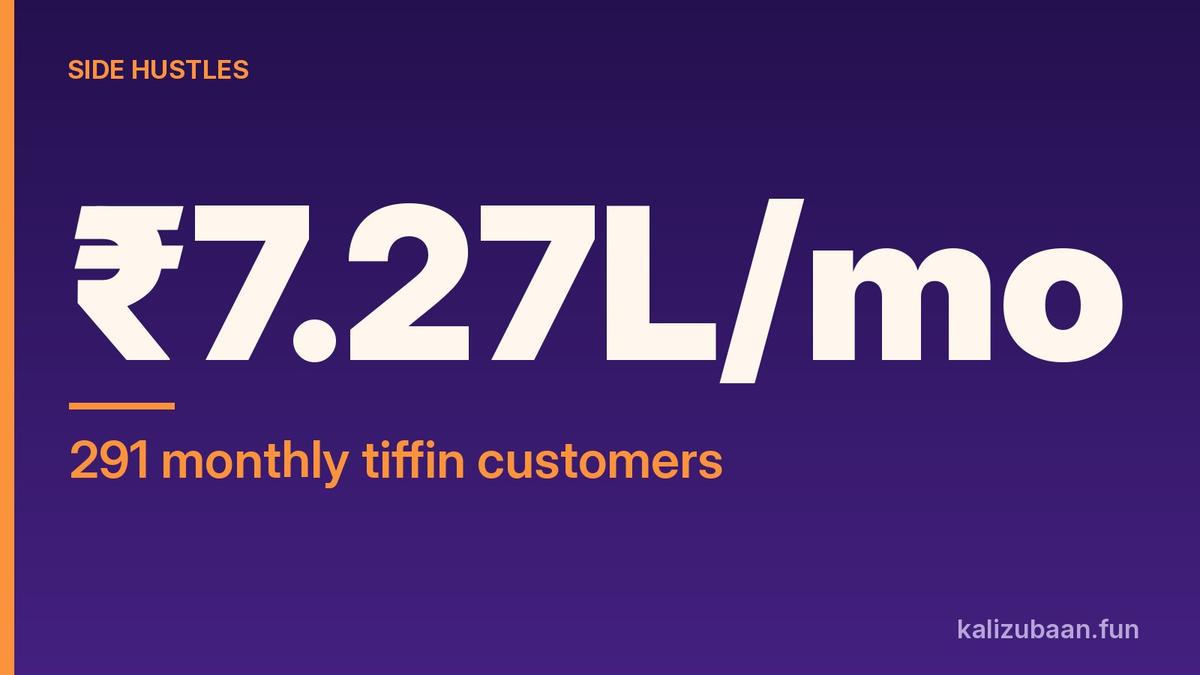
In January, her tiffin service had 20 customers. By February it had 125. Now it has 291.
Each one pays ₹2,500 a month. That is roughly ₹7.27 lakh in monthly revenue, and she still shows up at her bank job every day.
Quick answer
- The story comes from an X post by Ankit Pandey about his friend, a bank employee in Varanasi, as reported by The Economic Times. These are his figures, not audited accounts.
- At 291 customers paying ₹2,500 a month, the business brings in approximately ₹7.27 lakh in monthly revenue.
- Total monthly spending is put at approximately ₹3.03 lakh, which leaves an estimated operating surplus of ₹4.24 lakh a month.
- She runs it with three e-rickshaws, three delivery boys, one chef and two salesmen, and has no plans to quit her job.
From 20 customers to 291
Pandey says his friend started a simple tiffin business in January with just 20 customers. By February, the number had jumped to 125.
When ET reported the story, it had reached 291 customers. Her buyers are students and workers across Varanasi.
That is the whole pitch. No app, no funding round, no fancy office. Just a daily meal that people are willing to pay for every month.
"Tiffin" is an Indian English word for a meal, and in many parts of India it means a packed lunch. Mumbai's dabbawalas famously deliver tiffin carriers to offices. Her business sells the same everyday habit.
The numbers, as reported
Everything in this section comes from Pandey's post as reported by ET. We have not seen her books, and neither has ET.
Price. ₹2,500 per customer per month.
Revenue. At 291 customers, approximately ₹7.27 lakh a month.
Expenses. The ET article text lists food at ₹1.80 lakh and miscellaneous costs at ₹10,000. It puts total monthly expenditure at approximately ₹3.03 lakh.
Surplus. Against ₹7.27 lakh of revenue, ET calculates an estimated operating surplus of ₹4.24 lakh a month, "based on the figures in the post."
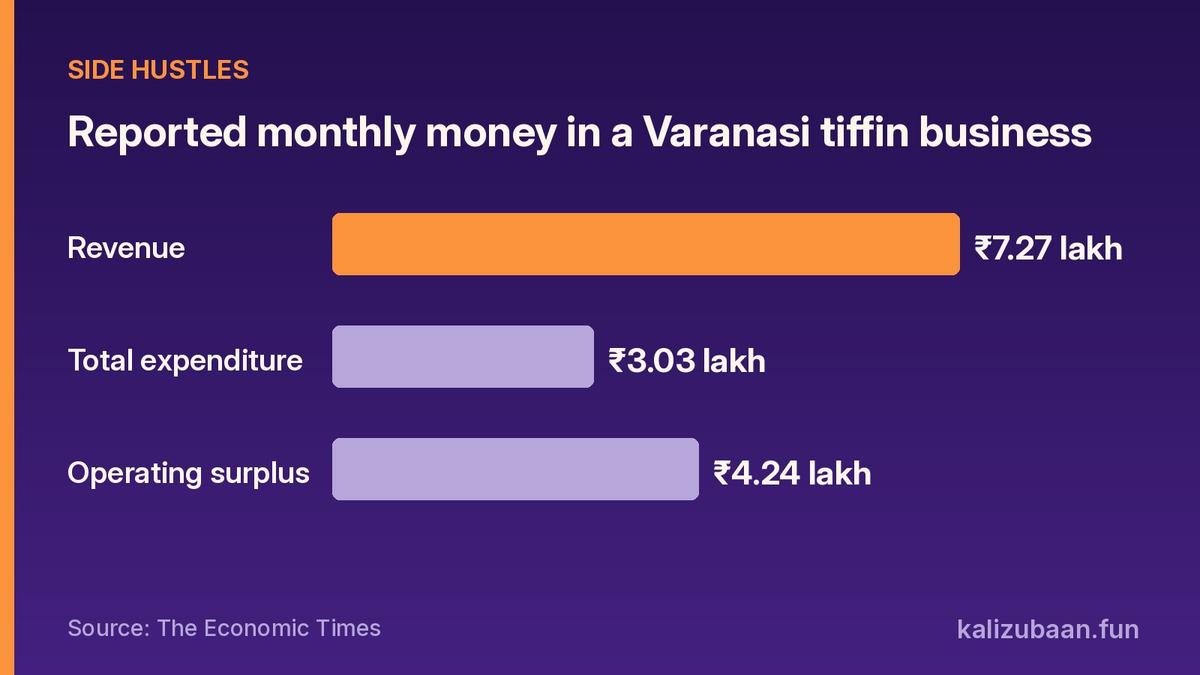
Source: The Economic Times
Salary comparison. Pandey claims her bank salary is now around 10 times lower than what the side business makes. He does not say whether he means revenue or surplus.
What the numbers leave out
The headline math is simple multiplication: customers times monthly price. That is revenue, not money in her pocket.
The missing expense lines. Food and miscellaneous costs together come to far less than the ₹3.03 lakh total. The article text we read does not itemise the rest.
The team itself tells you where much of it likely goes: three delivery boys, one chef, two salesmen, and three e-rickshaws to run. Those costs are real even if the article does not list them line by line.
Operating surplus is not profit after tax. ET calls the ₹4.24 lakh an estimated operating surplus. Tax, equipment replacement and other one-off costs are not part of that figure.
Customer count can move. Monthly subscribers can cancel. Students leave for holidays, and workers change jobs. A count of 291 is a snapshot, not a guarantee.
One commenter on the post doubted the setup, asking how a single person could cook for so many people. That is a fair question for any food business at this size, and the answer is the hired chef and team.
Why she is not quitting the bank job
ET's headline asks the obvious question: why keep a 9-5 job when the side business earns far more? The article does not give her own explanation, so we will not invent one.
But the internet's reaction captures the common logic. One commenter wrote, "Smart move build the business before quitting the job." Another said they would have quit and gone full time.
For most people starting a side hustle in India, a salary gives three things a young business cannot: a fixed monthly income, a cushion for bad months, and a credit history that helps with loans. Keeping it while the business proves itself is a low-risk way to grow.
How to test a tiffin service in your city
If you can cook well and you live near colleges, hostels or offices, a monthly tiffin plan is one of the simplest food businesses to test.
- Start with a handful of paying customers. She began with 20. Sell a monthly plan to people you can reach directly, like hostel students, PG residents or office colleagues.
- Price the plan per month, not per meal. A monthly fee, like her ₹2,500 plan, gives you predictable cash flow and helps you buy ingredients in bulk.
- Track food cost per customer. Food is the one big expense line the article lists. Know yours before you add customers.
- Solve delivery early. Her setup runs on e-rickshaws and delivery boys. Reliable, on-time delivery is what keeps subscribers renewing.
- Get a food licence. Check FSSAI registration requirements for home and small food businesses before you scale.
- Hire before you burn out. A chef and helpers are what let her keep a full-time job.
Check your job rules first
This is the part most viral posts skip. Many employers, including banks, have rules on employees running outside businesses.
Before you start, read your appointment letter, employment contract or staff service rules for moonlighting clauses. If anything is unclear, ask HR in writing.
A quick tax note
A tiffin business earns business income, which goes into your income tax return alongside your salary. Depending on turnover, GST registration or presumptive taxation may also come into play.
This is information only. Talk to a chartered accountant (CA) before you file.
FAQs
How much does the Varanasi tiffin business earn? According to Pandey's X post, as reported by ET, about ₹7.27 lakh a month in revenue, with an estimated operating surplus of ₹4.24 lakh after approximately ₹3.03 lakh in expenses.
How much does each customer pay? ₹2,500 a month, and the business serves 291 customers, mostly students and workers.
How big is the team? Three e-rickshaws, three delivery boys, one chef and two salesmen, according to Pandey.
Are these figures verified? No. They come from one person's social media post about his friend. Treat them as a reported example, not a benchmark.
Results vary; nothing here is a promise of income.
What would you charge for a monthly tiffin plan in your city? Tell us in the comments.
Sources
Tagged Topics
Keep reading


Thanks for reading Kali Zubaan
Explore more articles in Side Hustles or return to the main publication feed.