₹48,582 in 30 Days After Quitting a ₹25 LPA Job: The Split
Kamal Tolani left a ₹25 LPA corporate job to sell fashion jewellery online. His first 30 days brought ₹48,582 in sales, almost all from Amazon. Here is what the numbers do and don't tell you.
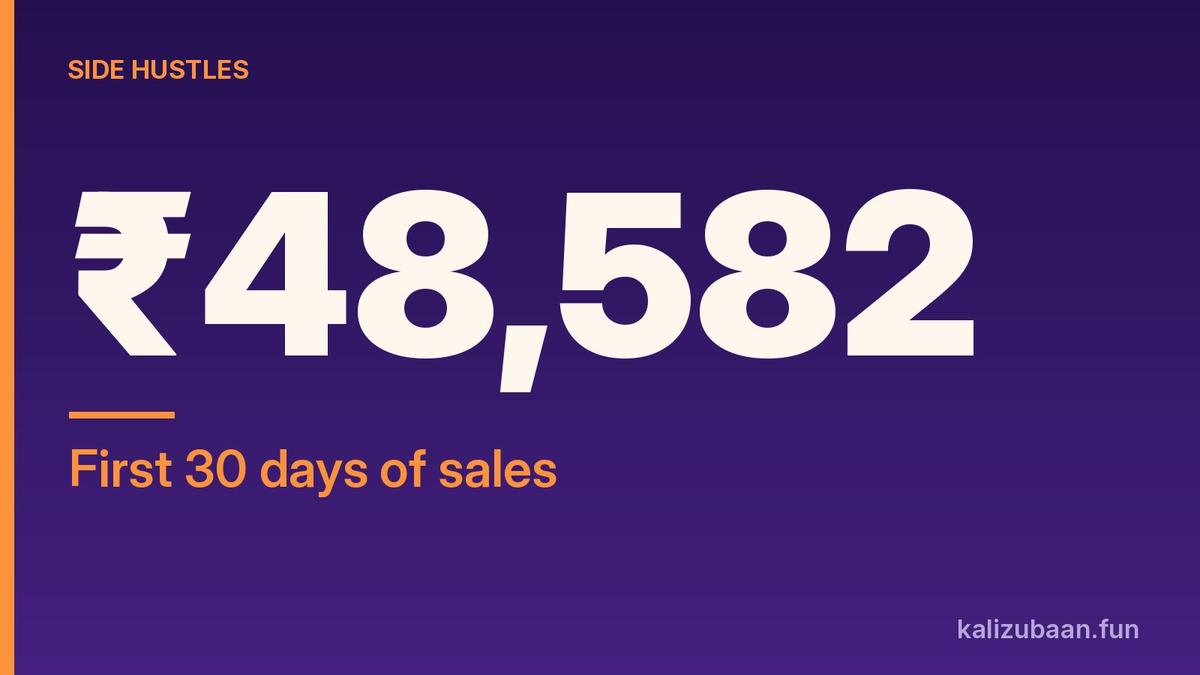
Kamal Tolani had a ₹25 LPA corporate job, a secure salary and, in his words, "corporate comfort". In September he walked away from it to sell fashion jewellery online. Thirty days later he posted his numbers on Instagram: ₹45,382 on Amazon, ₹3,200 on Meesho and ₹0 on Flipkart.
That adds up to ₹48,582 in his first month. It is nowhere near the salary he left. And that is exactly why the post is worth studying before you start your own online store.
Quick answer
- Kamal Tolani says his first 30 days of e-commerce sales came to ₹48,582 across three platforms.
- Amazon brought in ₹45,382, Meesho ₹3,200 and Flipkart nothing at all.
- These are sales figures he shared himself, not profit. Ads, returns and platform costs are not in the number.
- You don't have to quit a job to run this test. A small online store can start as a side hustle from home.
Who he is and what he shared
Tolani is a Rajasthan-based seller who, according to Hindustan Times, quit his job in September to start an e-commerce business. He is building a fashion jewellery brand.
"I am building a fashion jewellery business, focusing on trendy and affordable jewellery products for everyday wear and different occasions," he told Hindustan Times.
His Instagram caption was short: "I quit my 25 LPA corporate job to build something of my own. And today, I've completed my first month of e-commerce sales." The video then walked through what his first month "actually looked like across Amazon, Meesho and Flipkart".
So the claim is specific: one month, three platforms, one total. The Times of India reported the same ₹48,582 figure.
The first-month split, platform by platform
Here is how his reported sales break down.
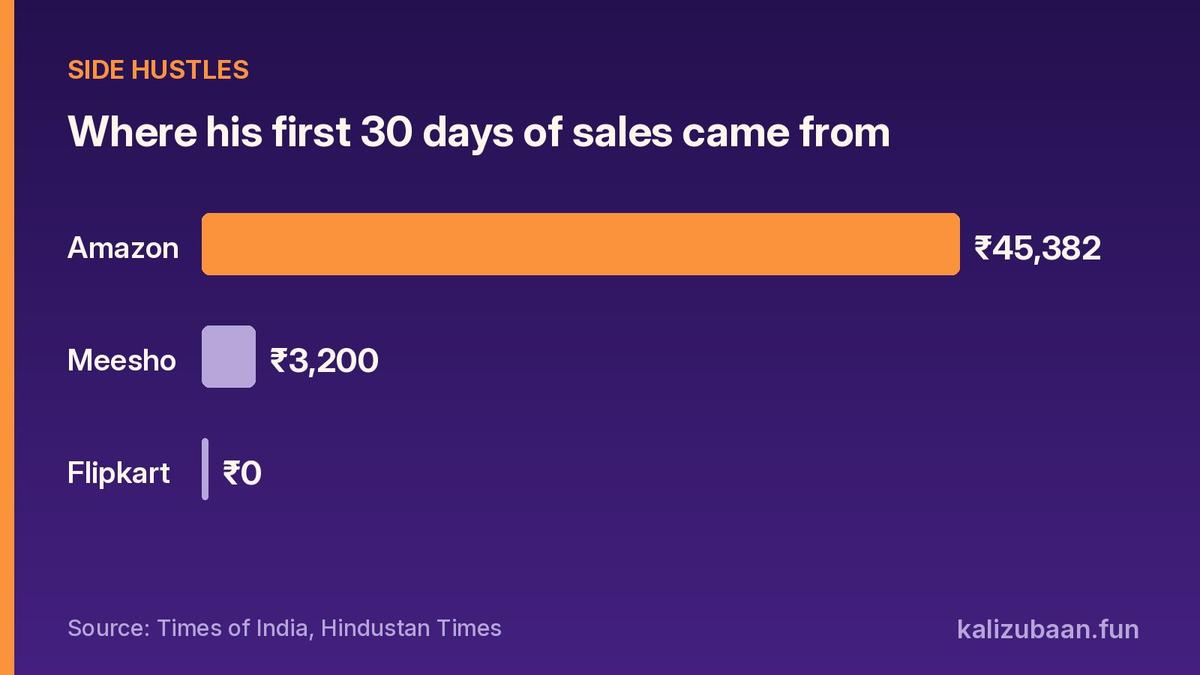
Source: Times of India, Hindustan Times
1. Amazon: ₹45,382. Almost all of his revenue came from one marketplace. The Times of India noted that the figures show a clear difference between platforms, with Amazon accounting for almost all of his first-month revenue.
2. Meesho: ₹3,200. A small start. Meesho is built around low prices and value buyers, so it often needs a different product mix and pricing than Amazon.
3. Flipkart: ₹0. No sales in the first month. That doesn't mean the platform is useless for him. It may simply need more time, better listings or a different approach.
The lesson for a new seller is simple. Don't assume every marketplace will behave the same. One may work quickly while another stays silent for weeks.
Sales are not salary
The headline number is easy to misread, so it's worth being careful.
It is sales, not take-home pay. Tolani's post lists what he sold on each platform. The reports don't share his product costs, marketplace fees, shipping, ad spend or returns. In e-commerce, those can eat a large part of the sales figure.
His own list of daily work tells you where the money goes. He said his life changed from "fixed salary and corporate comfort" to "just products, orders, ads, returns". Each of those words is a cost line or a time cost.
Price per item matters. One commenter on his post, quoted by the Times of India, pushed back on his pricing: "350 is not a high ASP! High ASP is called 1500 to 2k per unit." ASP means average selling price. At a low price per piece, you need many more orders, and every return hurts more.
None of this makes his start a failure. Tolani himself said, "Maybe it works. Maybe it doesn't." He wants to document the uncertainty, small wins and failures. That honesty is rarer than the number.
The quiet decision that bought him time
The most useful detail in the story is not on the thumbnail. Tolani told Hindustan Times that he moved from Mumbai to Ahmedabad, where he already owns a house.
"Shifting here significantly reduced my monthly living expenses and gave me a stronger financial runway to focus on building the business," he said. He also started the business completely from home, keeping the setup lean.
That is the real playbook. A new online store rarely pays a full salary in month one. What keeps you going is low fixed costs and enough savings to survive the slow months. He also said his wife and parents were very supportive, which matters more than most business advice admits.
How to test an online store from India without quitting
If his story makes you curious, here is a careful way to try it as a side hustle first.
- Pick one narrow product line. Tolani chose affordable everyday jewellery. Choose something light, easy to ship and hard to break.
- Start on one marketplace. His numbers suggest platforms behave very differently. Learn one well before spreading across three.
- Track profit, not just sales. Keep a simple sheet with product cost, fees, shipping, ads and returns for every order.
- Price for returns. Low-priced items get returned too. Build that into your margin from day one.
- Check your employment contract. Many Indian companies have moonlighting or conflict-of-interest rules. Read yours before you list a single product.
- Sort out registration and tax early. Selling on Indian marketplaces usually needs GST registration and proper records. Ask a CA what applies to you.
Only quit when the store's profit, not its sales, covers your monthly costs for a few months in a row.
Mistakes to avoid
- Comparing month-one sales with a full salary. It is a different kind of money, and month one is the hardest.
- Burning cash on ads too early. Fix listings, photos and pricing before you pay for traffic.
- Ignoring returns. They hit both your margin and your time.
- Leaving a job without a runway. Tolani cut his living costs before betting on the business. Copy that part first.
FAQs
Did Kamal Tolani earn ₹48,582 in profit? No. That figure is his reported sales across Amazon, Meesho and Flipkart in his first 30 days. His costs were not shared.
Why did Flipkart show ₹0? He didn't explain it in the reports. New sellers often see sales start on one platform before others, depending on listings, pricing and ads.
Can I start an online store while keeping my job? Many people do, as long as their employment contract allows it. Starting small from home, as he did, keeps the risk low.
What does he sell? Trendy and affordable fashion jewellery for everyday wear and different occasions, according to his interview with Hindustan Times.
Would you leave a ₹25 LPA job if month one looked like this? Tell us in the comments.
Results vary; nothing here is a promise of income. Tax and contract points are general information only, so check with a CA or lawyer for your situation.
Sources
Tagged Topics
Keep reading

Thanks for reading Kali Zubaan
Explore more articles in Side Hustles or return to the main publication feed.


