$2.60 an Hour to Film Chores: India's Newest Side Hustle Jobs
Indians are being paid to film themselves cooking, folding laundry and cutting hair to train AI robots. What these side hustle jobs pay, who hires, and the catch.

In a small town in Tamil Nadu, a 24-year-old woman clips her smartphone to a headset and starts chopping a carrot. The phone records every movement of her hands. She does this for a few hours a day, at about $2.60 an hour, and earns around $120 a month.
Sneha Jegadish is part of one of the strangest side hustle jobs in India right now. AI companies need millions of hours of video of real people doing real chores, so they can train robots to do the same work.
Quick answer
- Indian workers are paid to wear head cameras while cooking, cleaning, folding laundry, stitching garments or cutting hair. The footage trains so-called physical AI robots.
- NPR reports chore recorders earning about $2.60 an hour. A science teacher told the BBC she gets two to three dollars per hour.
- One collection company told the BBC it pays $5 to $10 for eight to 10 hours of recorded work, so rates vary widely.
- It can be flexible extra income, but it is low-paid, often repetitive, and in some factories workers were not told why they were being filmed.
What this side hustle job actually is
The industry calls it egocentric data: video shot from a person's own point of view, usually with a camera on the head. Robots cannot learn household chores from internet videos alone.
"Think of today's AIs as brains without a body," Prathosh A.P., a professor at the Indian Institute of Science in Bengaluru, told NPR. The robots need to learn motor skills from humans.
Manish Agarwal, founder of Humyn Labs, explained to the BBC why the data has to be made from scratch. "There is no existing internet archive of embodied human activity," he said.
So companies pay people to record ordinary work: kitchens being cleaned, clothes being folded, garments being cut, beards being trimmed.
What the work pays
The figures in the reports are small, but for some workers they matter.
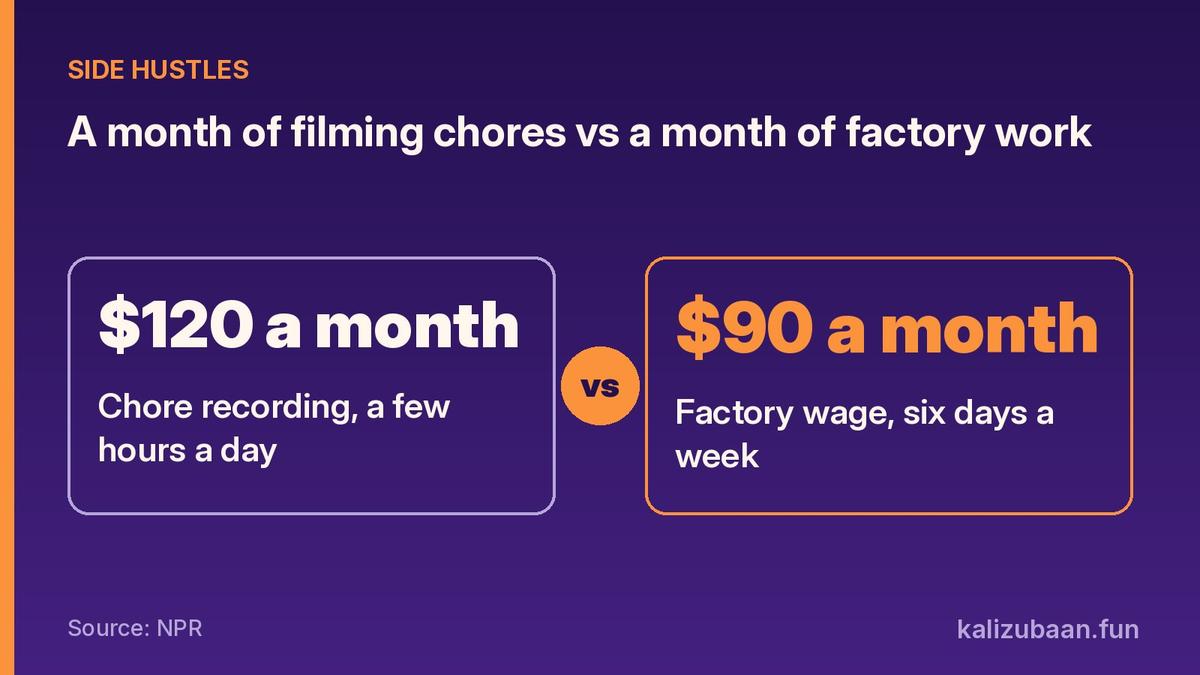
Jegadish, in Karur, earns around $120 a month by recording two or three hours of housework a day, NPR reports. Textile worker Kannagi Periyasaamy is paid about $2.60 an hour to record herself folding and packing aprons at her factory.
In Andhra Pradesh, science teacher Jolly Arifur told the BBC she has been strapping a camera on her head for the past seven months while scrubbing, cooking, sweeping and folding laundry. "I get paid two to three dollars per hour," she said. She fits it around her teaching and her young son.
Source: NPR
That comparison is striking. NPR also met a textile worker in the same town who has worked in a factory for 10 years, six days a week, and makes $90 a month. A few hours of filming chores at home paid Jegadish more.
Not every company pays by the hour. Shahil Baig, co-founder and CEO of Rashdan Technologies, told the BBC his company pays $5 to $10 for eight to 10 hours of recorded work. He said it pays more when workers agree to wear multi-camera rigs.
Who is hiring for this kind of work
The BBC and NPR named a few companies working in this space in India.
- Objectways, in Karur, Tamil Nadu, pays hundreds of people across India to record domestic jobs. It also runs a floor set up like a three-bedroom house where staff record cooking and cleaning.
- Rashdan Technologies collects video of industrial tasks, farming, household chores and small business work like pottery, embroidery and candle-making.
- Humyn Labs, with bases in Bangalore and San Francisco, has 96,000 data collectors across Latin America and Southeast Asia, and filters and labels the footage for clients.
Agarwal told the BBC he expects dozens more competitors to emerge in India this year. More competition could mean more jobs, but he also expects the value of raw recording work to erode quickly.
The catch: consent, privacy and your own job
This is not a clean, happy gig story.
At a textile factory in Karur, NPR found a worker who was told to wear a GoPro without being told it was training robots to do her job. "Nobody told me anything about it," she said. Astha Kapoor of the Aapti Institute called it "exploitation of labor."
Bino Paul, a professor at TISS Mumbai, told the BBC it is too early to say whether workers are training the machines that will replace them. "By the time workers realise what they have participated in, things may have gone too far," he warned.
Experts also told NPR that home robots are not around the corner in India, because they cost a lot and use a lot of power. Even so, Jegadish says she cannot wait for a robot to take over the tiresome chores, even if it costs her this gig.
How to approach these side hustle jobs safely
- Ask exactly what is being recorded. Reputable firms say they record hands, not faces, and blur faces when more of the scene is captured.
- Check your home. Make sure family members, documents and screens are not in the frame.
- Get the pay terms in writing: per hour or per batch, and how footage is rejected or approved.
- Never pay to join. A genuine data collection job should not ask you for a registration or training fee.
- Treat it as extra income. The pay is in dollars, but the amounts are small and the work may disappear as robots improve.
FAQs
How much do these AI chore recording jobs pay in India? Reported pay ranges from two to three dollars per hour for a home recorder to about $2.60 an hour in Karur. One company pays $5 to $10 for eight to 10 hours of recorded work.
Can I do it from home? Yes, some recorders film their own housework at home with a phone clipped to a headset, as Sneha Jegadish does.
Is it a full-time job? For most people in these reports it is part-time. Jegadish records a few hours a day, and Arifur fits it around teaching.
Is my privacy at risk? It can be. Firms told the BBC they blur faces and drop personal details, but you should confirm what is filmed and how it is used before you agree.
Results vary; nothing here is a promise of income.
Would you film your daily chores for an AI company? Tell us in the comments.
Sources
Tagged Topics
Keep reading



Thanks for reading Kali Zubaan
Explore more articles in Side Hustles or return to the main publication feed.


